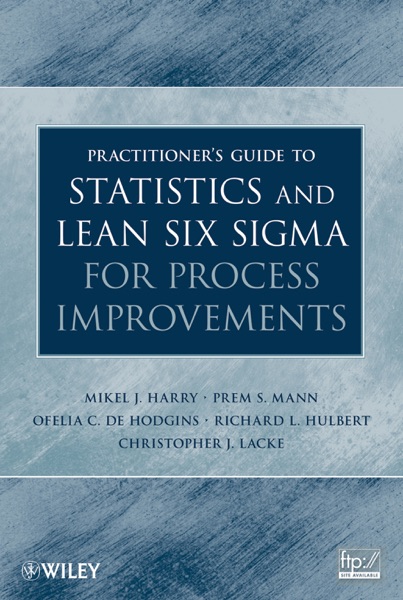
Six Sigma
📖 About the book
Six Sigma by Michael Harry and Richard Schroeder, published in 2000, provides a comprehensive overview of the data-driven methodology that transformed companies like Motorola and GE. Harry, one of the primary architects of the system, argues that high-quality is not just a manufacturing goal but a business strategy for increasing profitability. By using statistical tools to reduce Process Variation, Six Sigma aims for 'near-perfection'—defined as no more than 3.4 defects per million opportunities—fundamentally changing how corporations view quality control.
The core of the book is the DMAIC Framework: Define, Measure, Analyze, Improve, and Control. Harry details how to use statistical analysis to identify the root causes of errors and how to design experiments to optimize performance. He introduces the concept of the Six Sigma Hierarchy (Green Belts, Black Belts, Master Black Belts) as the specialized workforce required to drive transformation. The focus is on using hard data rather than intuition to make decisions, ensuring that every improvement is measurable and directly impacts the bottom line.
This is mandatory reading for quality engineers, data analysts, and executives leading large-scale efficiency programs. Readers gain value by learning how to bridge the gap between technical metrics and financial results. Practical applications include utilizing Statistical Process Control (SPC) to monitor output and implementing 'Project Charters' to align Six Sigma efforts with corporate goals. By adopting this rigorous methodology, organizations can significantly reduce costs, increase customer satisfaction, and build a culture of data-driven discipline that ensures long-term operational excellence.
💡 Key takeaways
Apply the DMAIC Methodology (Define, Measure, Analyze, Improve, Control) to systematically solve complex operational problems using data-driven evidence.
Focus on Reducing Variation in your core business processes to ensure consistent quality and minimize the unpredictable costs associated with defects and rework.
Develop a Belt-Based Leadership Structure to create a dedicated group of specialists who possess the statistical expertise needed to lead high-impact improvement projects.
❓ FAQ
Is "Six Sigma" by Michael Harry free to download?
Yes. BookHubs provides a free preview for "Six Sigma". For the full legal text we link to OpenLibrary (Internet Archive), which is also free to read.
What is "Six Sigma" about?
Download the guide to data-driven quality for free. Master the DMAIC method to eliminate defects and achieve near-perfect operational performance.
How long does it take to read "Six Sigma"?
At an average reading pace of ~250 words per minute, "Six Sigma" (304 pages) takes roughly 456 minutes — about 7.6 hours. The 3 key takeaways on this page cover the core ideas in under 5 minutes.
What is the ISBN of "Six Sigma"?
The ISBN of "Six Sigma" by Michael Harry is 978-0385494373, published by Currency.
📚 Related books
All books →
7 Habits of Highly Effective People
Stephen Covey

High Output Management
Andrew Grove

The Righteous Mind
Jonathan Haidt

Antifragile
Nassim Taleb

Business Model Generation
Osterwalder, Pigneur

Management
Peter Drucker